The Building Blocks: Amino Acids, Peptides, and Proteins
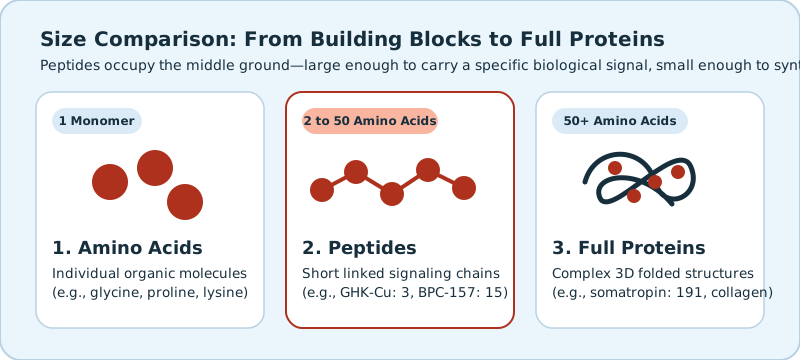
Every living cell uses 20 standard amino acids like letters of an alphabet. When your body links just a few of those letters together—say, three amino acids as in GHK-Cu (glycine-histidine-lysine) or fifteen amino acids as in BPC-157—the resulting molecule is called a peptide.
- Oligopeptides (2–20 amino acids): Include tripeptides like GHK-Cu (3 amino acids), tetrapeptides like Epithalon (4 amino acids), pentapeptides like Ipamorelin (5 amino acids), and heptapeptides like Semax and Selank (7 amino acids).
- Polypeptides (20–50 amino acids): Include Thymosin Alpha-1 (28 amino acids), Sermorelin and CJC-1295 (29 amino acids), and Thymosin Beta-4 (43 amino acids; related in research literature to TB-500).
- Proteins (50+ amino acids): Once a chain exceeds roughly 50 amino acids and folds into a complex three-dimensional structure—such as full-length human growth hormone (191 amino acids) or collagen—biochemists classify it as a protein.
How Do Peptides Work Inside Living Systems?
Unlike broad-spectrum small-molecule drugs that can diffuse across many cell types, most peptides work via a key-and-lock receptor mechanism:
- Receptor Binding: Each peptide's specific amino acid sequence folds into a shape that fits a corresponding cell-surface receptor (such as the GHRH receptor, the MC4R melanocortin receptor, or growth-factor receptors on fibroblasts).
- Intracellular Signal Cascade: When the peptide binds the receptor, it triggers an internal second-messenger cascade (such as cAMP or calcium signaling) that instructs the cell nucleus to upregulate specific genes or release stored hormones.
- Enzymatic Breakdown: After delivering its signal, the peptide is rapidly cleaved by endogenous peptidase enzymes back into ordinary amino acids that the cell recycles.

Familiar Peptides You Have Probably Heard Of
Although peptides can sound like an unfamiliar laboratory topic, several well-known biological molecules are peptides or small peptide hormones:
- Insulin: Sitting right on the boundary between a large polypeptide and a small protein at 51 amino acids, insulin is the peptide hormone that signals cells to absorb glucose from the bloodstream.
- Oxytocin: A 9-amino-acid peptide hormone produced in the hypothalamus and released by the pituitary gland that plays an established role in social bonding, uterine contractions, and lactation.
- Glutathione: A 3-amino-acid tripeptide (glutamate, cysteine, and glycine) that acts as one of the body's primary intracellular antioxidants, helping protect cells from oxidative damage.
- Collagen Peptides: When full-length structural collagen protein is enzymatically hydrolyzed into shorter peptide chains, those smaller fragments are more easily digested and absorbed to supply amino acids for connective tissues, skin, and joints.
Endogenous vs. Synthetic Peptides
According to Nature Reviews Drug Discovery, over 60 peptide drugs have been approved worldwide and hundreds more are in clinical development. In pharmaceutical and laboratory research, scientists also design synthetic peptide analogs by modifying specific amino acids in a natural sequence. Why modify a natural sequence?
- To Resist Rapid Enzymatic Cleavage: Natural GHRH or ACTH fragments break down in blood plasma within minutes. Research in Frontiers in Chemistry discusses advances in peptide synthesis and modification that improve peptide stability.
- To Isolate One Biological Action: Full-length growth hormone affects blood sugar, IGF-1, bone, and fat tissue simultaneously. Researchers isolated Fragment 176-191 and AOD-9604 to study the C-terminal lipolytic (fat-metabolizing) tail separately from the growth-promoting region.
Four Functional Types of Peptides You Might Encounter
In dermatology, biochemistry, and pharmacology literature, peptides are often grouped into four functional classes based on how they act:
- Signal Peptides: Direct cellular messengers that bind receptors to trigger a specific biological process—such as instructing dermal fibroblasts to produce collagen or elastin, or signaling pituitary cells to release hormones.
- Carrier Peptides: Molecules that bind and transport trace mineral cofactors (most notably copper or manganese) into tissues where those minerals support enzymatic activity and wound repair; copper tripeptide-1 (GHK-Cu) is the classic example.
- Neurotransmitter-Inhibiting Peptides: Used primarily in topical cosmetic formulations (such as acetyl hexapeptide-8, known as Argireline), these peptides are studied for modulating superficial neuromuscular junction signaling involved in facial expression lines.
- Enzyme-Inhibitor Peptides: Peptides studied for slowing down enzymes (such as matrix metalloproteinases or elastase) that degrade structural proteins like collagen and elastin.
Peptides in Everyday Food vs. Concentrated Signaling Peptides
You already consume peptides every day through ordinary nutrition. Whenever you eat protein-rich foods—such as bone broth, fish, milk and dairy products, eggs, soybeans, and meat—digestive enzymes cleave those dietary proteins into short bioactive peptides and individual amino acids so the intestinal tract can absorb them.
- Dietary Protein & Hydrolyzed Collagen: Food-derived peptides provide a natural mix of amino acid building blocks (such as glycine, proline, and hydroxyproline) alongside everyday nutrients.
- Concentrated Signaling Peptides: Formulated or synthesized to study specific receptor pathways rather than general nutrition. Learn why digestive enzymes break down most intact signaling peptides in our guide on how administration routes work.
Safety Overview & Medical Supervision Boundaries
Safety depends on the peptide class, the route of exposure, and the maturity of human clinical evidence. Topical cosmetic peptides in creams and serums and dietary peptides from food are generally well tolerated because they act locally or serve as nutritional building blocks. By contrast, peptides investigated for systemic effects can produce significant endocrine, vascular, or immune changes. As a Journal of Biomedical Science review explains, systemic peptide candidates require rigorous quality control and professional medical supervision. Safety during pregnancy or breastfeeding is not established for investigational peptides, and anyone who is pregnant, nursing, or managing a medical condition should consult a qualified healthcare provider before considering any peptide product. See our full guide on whether peptides are safe.
Scientific References
- Nature Reviews Drug Discovery — review of peptide therapeutic development
- Frontiers in Chemistry — advances in peptide synthesis and modification
- Journal of Biomedical Science — systemic peptide safety and medical supervision (PMC6117322)