
Every Peptide Question, Answered in Plain English

Peptides are short chains of 2 to 50 amino acids that act as targeted biological messengers.

For research peptides, our best pick is Oath Research: its policy offers refunds or replacements for product that misses stated specifications or purity. Opened or used product is excluded. Read Oath’s policy

The 8 Questions Curious Newcomers Ask First

Some are FDA-approved prescription medications, a small number are eligible for pharmacy compounding, and many widely discussed compounds are unapproved laboratory research materials requiring third-party purity and identity testing.

Layered blue and peach paper shapes around an open blank notebook on a kitchen table
Independent analytical verification—using HPLC-UV for purity and LC-MS for molecular identity—distinguishes verified research materials from untested stock.

What are peptides, and how do they differ from proteins?

How 2-to-50 amino acid chains act as specific cellular signaling messengers.

Are peptides safe, and what are the real risks?

Why FDA-approved medicines, compounded peptides, and animal-only compounds carry different risk profiles.

Do I need a prescription for peptides in the United States?

Understanding FDA approval, 503A/503B bulk compounding lists (current as of April 22, 2026), and research materials.

What peptide should a beginner read about first?

An orientation map comparing tissue repair, growth-hormone signaling, skin, and metabolic families.

Where do people buy peptides, and how do you verify a COA?

How to check batch-specific HPLC-UV purity and LC-MS mass spectra before trusting any source.

How do the top peptide sources compare on testing and transparency?

Our 50-point scoreboard across COA documentation, shipping, support, consistency, and range.

How much do peptides cost across pharmacies and suppliers?

Why synthesis complexity, lyophilization, and independent third-party testing drive pricing.

How do you store freeze-dried and reconstituted peptides safely?

Temperature, light, freeze-thaw cautions, and household safety rules for peptide vials.

How Peptides Work, Realistic Expectations, and Why Clinical Consultation Comes First

While a full protein folds hundreds or thousands of amino acids into structural tissue or enzymes, a peptide links between 2 and 50 amino acids into a short signaling chain. According to literature indexed in the National Institutes of Health database, endogenous and therapeutic peptides act as receptor-specific messengers that break down into constituent amino acids—yet their safety and clinical utility depend on whether a specific compound has completed controlled human trials and whether its manufacturing quality has been verified.

According to FDA consumer updates on unapproved peptides, many widely discussed peptides have never been approved by the U.S. Food and Drug Administration for general human use, making it essential to separate FDA-approved prescription medications dispensed by licensed pharmacies from unapproved laboratory reagents.

Realistic Expectations and Individual Variation

Peptides are studied as biological signaling modulators, not instant shortcuts. Even where clinical evidence exists, biological processes such as tissue remodeling, metabolic adaptation, and endocrine signaling unfold gradually over time rather than overnight. Moreover, individual variation is substantial: two people in a clinical cohort can respond quite differently depending on baseline physiology, age, genetics, receptor sensitivity, sleep quality, stress levels, and underlying health status.

The Foundation Still Matters: Sleep, Nutrition, and Activity

No signaling molecule replaces foundational health habits. Research published in the Journal of Clinical Endocrinology & Metabolism emphasizes that endocrine and metabolic therapies are evaluated alongside appropriate nutrition, regular physical activity, restorative sleep, stress management, and adequate hydration. Without those fundamentals in place, isolated biochemical interventions cannot compensate for chronic sleep deprivation or poor nutrition.

Why Research and Clinical Consultation Precede Personal Health Decisions

Careful education and medical oversight must precede any personal health decision. Before considering any therapy, readers should review primary scientific literature—including introductory peptide education primers, independent evidence summaries such as Examine.com's supplement database, and peer-reviewed studies on PubMed—and consult a licensed healthcare provider. A qualified clinician can evaluate personal medical history, order appropriate diagnostic lab work, identify contraindications or drug interactions, and advise on FDA-approved medical options.
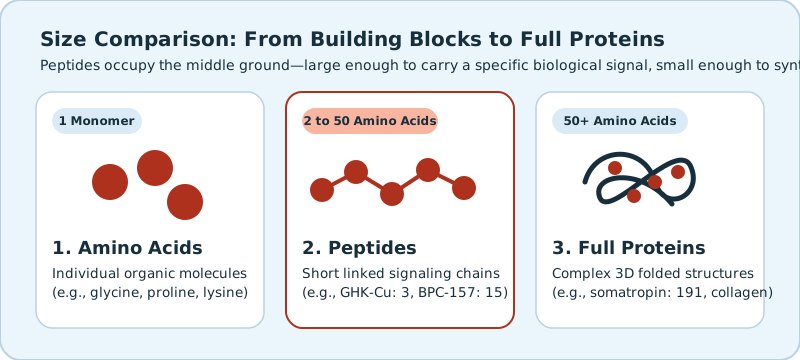
Diagram comparing single amino acids, short peptide chains of 2 to 50 amino acids, and complex folded proteins of 50 or more amino acids
Why size matters in biochemistry: peptides sit between individual amino acid nutrients and large folded proteins, allowing them to bind specific cell-surface receptors.

Core Getting-Started Guides

Before diving into individual compound names like BPC-157, CJC-1295, or GHK-Cu, understand how peptides work, how U.S. regulations separate prescription medications from research reference materials, and how analytical labs test what is inside a vial.

What Are Peptides?

How short chains of amino acids act as signaling messengers in the body, how they differ from proteins, and why delivery routes depend on molecular size.

Are Peptides Safe?

Why "peptides" aren't a single safety category: comparing FDA-approved drugs, animal-model compounds, and the risks of unverified purity.

Do I Need a Prescription?

The three legal lanes in the United States, including the status on FDA's bulk drug substances page current as of April 22, 2026 for 503A and 503B compounding.

Where Do I Buy Peptides?

How licensed pharmacies, telehealth clinics, and US research-peptide suppliers differ—and how to verify an independent Certificate of Analysis (COA).

Top Peptide Sources Compared

Our 50-point evaluation of six peptide suppliers across COA documentation, shipping, support, batch consistency, and catalog range.

What Should I Start With?

How to navigate the peptide landscape by research category, human vs. animal evidence maturity, and regulatory status without getting lost in jargon.

Explore Peptide Research by Biological Topic

Different peptide families are studied for distinct physiological systems—from metabolic GLP-1 and growth-hormone fragments to dermal copper tripeptides and thymic immune modulators. Choose a question below to see which compounds appear in published literature and how strong the human evidence is.

All 20 Individual Compound Explainers (A–Z)

Each compound guide explains what the molecule is, its biological origin, what published animal or human studies have examined, its U.S. regulatory status (on FDA's page current as of April 22, 2026), and how analytical laboratories verify it.

Compound Molecular Class / Origin Primary Research Focus U.S. Regulatory Status (Apr 2026)
AOD-9604 Modified hGH C-terminal fragment Adipose lipolysis & lipid metabolism Unapproved; Cat. 2 nomination withdrawn
BPC-157 15-AA synthetic gastric peptide Tendon, ligament & mucosal angiogenesis Unapproved; Cat. 2 nomination withdrawn
Cerebrolysin Porcine brain-derived peptide mixture Neurotrophic signaling & stroke recovery Approved in parts of Europe/Asia; not FDA-approved
CJC-1295 Synthetic GHRH analog Pituitary GHRH receptor signaling Unapproved; Cat. 2 nomination withdrawn
Dihexa Angiotensin IV hexapeptide derivative HGF/c-Met synaptogenesis in animal models Unapproved; Cat. 2 nomination withdrawn
Epithalon 4-AA synthetic pineal tetrapeptide Telomerase activity & circadian melatonin Unapproved; Cat. 2 nomination withdrawn
Fragment 176-191 C-terminal hGH fragment (AA 176–191) Selective fat oxidation vs. IGF-1 signaling Unapproved research peptide fragment
GHK-Cu Gly-His-Lys copper(II) tripeptide Dermal collagen remodeling & gene expression Cosmetic topical use; injectable Cat. 2 nomination withdrawn
Hexarelin Synthetic hexapeptide ghrelin mimetic Growth hormone secretagogue receptor binding Unapproved investigational secretagogue
Ipamorelin 5-AA selective pentapeptide GHRP Selective GH release with minimal cortisol/prolactin change Not FDA-approved; 503B Cat. 2 & withdrawn table entries
Melanotan II Cyclic alpha-MSH analog Melanocortin receptor binding & pigmentation Unapproved; Cat. 2 nomination withdrawn; FDA warnings
MOTS-c 16-AA mitochondrial-derived peptide AMPK pathway & metabolic homeostasis Unapproved; Cat. 2 nomination withdrawn
NAD+ Nicotinamide adenine dinucleotide coenzyme Mitochondrial redox & sirtuin/PARP enzymes Endogenous coenzyme; unapproved as injectable drug
Pentosan Polysulfate Semi-synthetic sulfated xylan polysaccharide Bladder mucosal layer & cartilage research Oral Elmiron FDA-approved (IC); injectable unapproved
PT-141 (Bremelanotide) Cyclic heptapeptide MC4R agonist Central nervous system melanocortin signaling FDA-approved as Vyleesi (Rx autoinjector)
Selank Synthetic tuftsin heptapeptide analog GABAergic modulation & enkephalin stability Used clinically in Russia; unapproved in U.S. (Cat. 2 withdrawn)
Semax ACTH-derived synthetic heptapeptide BDNF expression & cognitive/neuroprotective research Used clinically in Russia; unapproved in U.S. (Cat. 2 withdrawn)
Sermorelin 29-AA GHRH(1–29) amide analog Physiological pituitary growth hormone release Previously FDA-approved (Geref); discontinued for non-safety reasons
TB-500 Synthetic Thymosin Beta-4 derivative Actin regulation & cell migration models Unapproved; Cat. 2 nomination withdrawn
Thymosin Alpha-1 28-AA thymic immune peptide T-cell maturation & immune modulation Approved outside U.S.; U.S. Cat. 2 nomination withdrawn

Practical & Laboratory Reference Questions

Curious why peptides ship as freeze-dried powders, why temperature swings degrade amino acid chains, or how researchers design multi-compound studies? Our reference guides explain the underlying science without giving personal dosing or self-administration instructions.

How Do I Store Peptides?

Why lyophilized powders and reconstituted liquid solutions require different temperature, light, and freeze-thaw protections.

How Do I Reconstitute Peptides?

What lyophilization is, why bacteriostatic water contains 0.9% benzyl alcohol, and how concentration math works in laboratory settings.

How Do I Inject Peptides?

Why digestive enzymes break down many oral peptide chains, and how parenteral, intranasal, and topical delivery routes compare.

How Often Do I Inject Peptides?

How biological half-life, enzymatic cleavage, and receptor desensitization determine study timing across peptide classes.

How Do I Stack Peptides?

Why researchers study complementary receptor pathways (such as GHRH + GHRP) and why combining unapproved compounds multiplies unknowns.

Editorial Purpose & Independence: I Want Peptides is written and maintained by the editors of I Want Peptides as an educational reference. We do not provide medical advice, personal treatment recommendations, or human dosing instructions. Always consult a licensed physician regarding any prescription medication or health question.