What Is Hexarelin? Structure and Classification
Hexarelin is a synthetic hexapeptide (six-amino-acid peptide) belonging to the Growth Hormone Releasing Peptide (GHRP) family, designed for high metabolic stability and strong binding affinity at growth hormone secretagogue receptors (PubMed).
Like other peptides in the GHRP family, Hexarelin does not supply exogenous growth hormone directly. Instead, it acts on the hypothalamus and anterior pituitary gland to trigger a surge of endogenous somatotropin (growth hormone).
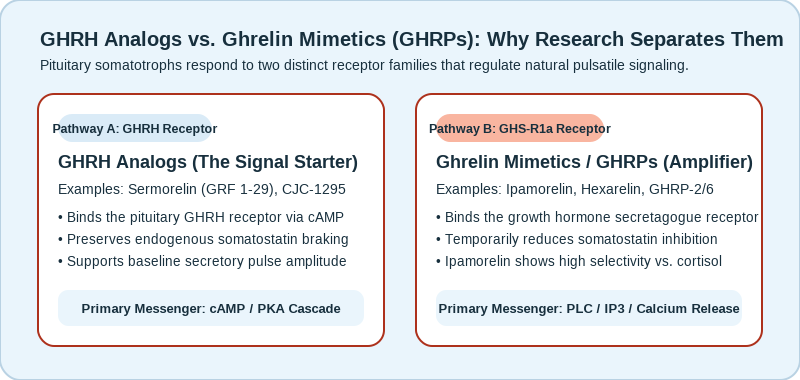
How Hexarelin Works: Dual Receptor Pharmacology
What makes Hexarelin scientifically distinct from later-generation secretagogues is that it binds two completely different receptor families in mammalian tissue:
1. Pituitary and Hypothalamic GHS-R1a (Ghrelin) Receptors
In the anterior pituitary gland and arcuate nucleus of the hypothalamus, Hexarelin is a full agonist of the Growth Hormone Secretagogue Receptor type 1a (GHS-R1a)—the endogenous receptor for the gut hormone ghrelin. Activating GHS-R1a stimulates phospholipase C and intracellular calcium mobilization in somatotroph cells while suppressing hypothalamic somatostatin (the inhibitory brake on GH release). In endocrine studies, acute administration of Hexarelin produces a pronounced pulse of plasma growth hormone over baseline (PubMed).
2. The CD36 Receptor and Cardiovascular Research
Uniquely among GHRPs, Hexarelin also binds a specific transmembrane glycoprotein in myocardial and vascular endothelial tissue identified as the CD36 scavenger receptor (Cardiovascular Research, NIH PMC).
Research has examined Hexarelin’s cardiac effects and potential role in cardiovascular disease (Endocrine, PubMed).
Why Hexarelin Is Less Widely Studied Than Ipamorelin: The Three Drawbacks
If Hexarelin produces the strongest acute GH pulse in its class, why did clinical researchers and peptide laboratories largely shift toward Ipamorelin or Sermorelin? Endocrine trials identified three major physiological trade-offs:
1. Rapid Receptor Desensitization (Tachyphylaxis)
When GHS-R1a receptors are repeatedly stimulated by a high-affinity agonist like Hexarelin, pituitary somatotrophs internalize and downregulate surface ghrelin receptors. The cited research examines secretagogue receptor desensitization following repetitive GHRP-6 administration (PubMed). To read more about how receptor downregulation works in endocrine signaling, see our guide on half-lives and receptor desensitization.
2. Non-Selective Cortisol, ACTH, and Prolactin Elevation
Unlike Ipamorelin, which was specifically engineered for selectivity at somatotrophs, Hexarelin cross-stimulates the hypothalamic-pituitary-adrenal (HPA) axis and pituitary lactotrophs. Human endocrine testing consistently documents acute post-administration rises in:
- Adrenocorticotropic Hormone (ACTH) and Serum Cortisol: Chronic cortisol elevation antagonizes insulin sensitivity, promotes visceral adiposity, and impairs sleep architecture.
- Serum Prolactin: Sustained prolactin elevation can suppress gonadotropin signaling and alter reproductive endocrine balance.
3. Ghrelin-Mediated Appetite Stimulation
Because GHS-R1a is the primary central receptor for ghrelin ("the hunger hormone"), Hexarelin stimulates hypothalamic neuropeptide Y (NPY) and agouti-related peptide (AgRP) neurons, triggering pronounced appetite increases (though slightly less intense than GHRP-6).
Comparison: Hexarelin vs. Other Growth Hormone Secretagogues
| Compound | Receptor Class | Acute GH Pulse Amplitude | Cortisol & Prolactin Impact | Receptor Desensitization |
|---|---|---|---|---|
| Hexarelin | GHRP (GHS-R1a + CD36) | Highest among GHRPs | Moderate-to-significant elevation | Rapid tachyphylaxis with continuous exposure |
| Ipamorelin | Selective GHRP (GHS-R1a) | Moderate, dose-dependent | Negligible (selective for GH) | Low desensitization in comparative studies |
| Sermorelin | GHRH(1–29) Analog | Physiological, pulsatile | None (acts via GHRH-R) | Preserves somatostatin feedback loop |
| CJC-1295 | Modified GHRH(1–29) Analog | Sustained trough/pulse elevation | None (acts via GHRH-R) | Extended half-life (especially with DAC) |
Safety Considerations and Regulatory Status
In human clinical trials, reported adverse effects of Hexarelin include transient facial flushing, water retention and peripheral edema, carpal-tunnel-like paresthesia (tingling in hands and fingers), increased hunger, and elevated fasting blood glucose due to growth hormone's counter-regulatory effect on insulin. Growth hormone and IGF-1 signaling raises safety questions in malignancy and diabetic retinopathy. Human reproductive safety is unestablished for Hexarelin. See Are Peptides Safe? and Side Effects & Risk Factors for complete details.
U.S. FDA & Anti-Doping Status: Hexarelin was never approved by the U.S. Food and Drug Administration for any clinical indication, and it cannot be lawfully compounded by U.S. pharmacies under Section 503A. In competitive athletics, Hexarelin is explicitly named as a prohibited substance at all times under Section S2.2.4 (Growth Hormone Releasing Factors) of the World Anti-Doping Agency (WADA) Prohibited List. To learn how U.S. peptide laws and third-party lab testing work, visit Do I Need a Prescription? and Where Do I Buy Peptides?.
Scientific References and Further Reading
- Hexarelin, a peptidyl GH secretagogue, induces GH release in humans - Journal of Endocrinological Investigation
- Cardioprotective effects of hexarelin and its analogues - Cardiovascular Research
- Desensitization of the GH secretagogue receptor following repetitive GHRP-6 administration - European Journal of Endocrinology
- Cardiac effects of hexarelin and its role in cardiovascular disease - Endocrine