What Is CJC-1295? (The Plain-English Explanation)
Natural growth hormone–releasing hormone (GHRH) is produced in the hypothalamus and travels to the anterior pituitary gland to trigger pulsatile secretion of somatotropin (growth hormone, or GH). However, native human GHRH(1–29) is cleaved within minutes in the bloodstream by the enzyme dipeptidyl peptidase-4 (DPP-4), giving it an extremely brief plasma half-life.
CJC-1295 is a synthetic peptide engineered by substituting four amino acids in the first 29 residues of human GHRH. Those four substitutions protect the peptide backbone from rapid enzymatic cleavage while enhancing its affinity for pituitary GHRH receptors. Unlike exogenous recombinant human growth hormone (rHGH), which replaces endogenous hormone production directly, CJC-1295 acts upstream on the somatotropic axis.
CJC-1295 With DAC vs. Without DAC (Mod GRF 1-29)
In scientific literature and laboratory catalogs, the name "CJC-1295" is applied to two related molecules with dramatically different pharmacokinetic half-lives (see our guide on peptide half-lives and pharmacokinetics):
| Feature | CJC-1295 With DAC | CJC-1295 Without DAC (Mod GRF 1–29) |
|---|---|---|
| Chemical Structure | Tetrasubstituted GHRH(1–29) + Drug Affinity Complex (DAC) moiety | Tetrasubstituted GHRH(1–29) (Modified GRF 1–29) |
| Albumin Binding | Covalently binds to circulating serum albumin | Does not covalently bind serum albumin |
| Plasma Half-Life | Extended over several days in human pharmacokinetic studies | Short (cleared within roughly half an hour) |
| Secretory Pattern | Sustained multi-day elevation of basal GH and IGF-1 while preserving pulsatility | Brief, discrete GHRH-receptor pulse that clears rapidly |
In two landmark human endocrine studies published in the Journal of Clinical Endocrinology & Metabolism (PMID 16352683; PMID 16936142), administration of CJC-1295 (with DAC) in healthy adults produced sustained, dose-dependent increases in mean plasma GH and serum IGF-1 concentrations over several days while preserving the natural circadian pulsatility of GH secretion.
How CJC-1295 Works in the Somatotropic Axis
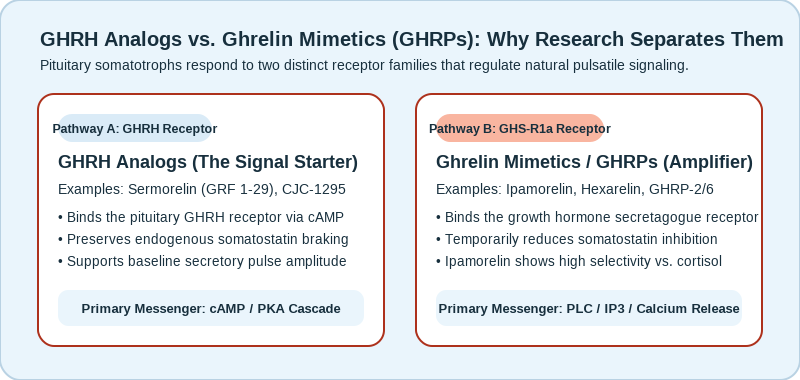
When CJC-1295 binds G-protein-coupled GHRH receptors on somatotroph cells in the anterior pituitary, it activates adenylyl cyclase and intracellular cyclic AMP (cAMP) signaling. That cascade stimulates both the transcription of new growth hormone mRNA and the release of stored GH vesicles into systemic circulation.
Downstream in peripheral tissues, pituitary growth hormone and liver-derived IGF-1 are investigated across several physiological domains:
- Skeletal Muscle Protein Synthesis: IGF-1 signaling supports cellular amino acid uptake, nitrogen retention, and muscle fiber repair (read more on muscle research peptides).
- Adipocyte Lipolysis: Growth hormone directly stimulates triglyceride mobilization in visceral and subcutaneous adipose depots (see weight-loss and metabolic pathways).
- Slow-Wave Sleep Architecture: Endogenous GHRH signaling is tightly coupled with nocturnal slow-wave sleep stages (see sleep and circadian peptides).
- Connective Tissue and Bone Turnover: Somatotropic signaling influences osteoblast activity and extracellular matrix collagen synthesis (see joint and cartilage research).
Dual-Receptor Synergy: Why CJC-1295 Is Studied Alongside Ipamorelin
In endocrine research, CJC-1295 (particularly the short-acting Mod GRF 1–29 form) is frequently studied alongside Ipamorelin, a selective growth hormone secretagogue receptor (GHS-R1a / ghrelin receptor) agonist. Because the two compounds bind completely separate receptor families on pituitary somatotrophs, they act through complementary mechanisms:
- CJC-1295 (GHRH Receptor Agonist): Increases intracellular cAMP, expanding the pool of synthesized GH and priming the somatotroph.
- Ipamorelin (GHS-R1a Agonist): Signals through phospholipase C (IP3/PKC) and functionally antagonizes hypothalamic somatostatin (the inhibitory brake on GH release).
Unlike first-generation GHRPs such as GHRP-6 or Hexarelin, which can elevate serum cortisol and prolactin, Ipamorelin exhibits high receptor selectivity for GH release. See our guide on how multi-pathway peptide combinations are studied.
How CJC-1295 Compares to Recombinant HGH, Sermorelin, and MK-677
- CJC-1295 vs. Recombinant HGH (Somatropin): Exogenous rHGH bypasses the pituitary gland entirely, creating supraphysiological hormone peaks and suppressing endogenous pituitary GH output via negative feedback. GHRH analogues like CJC-1295 remain subject to IGF-1 and somatostatin feedback regulation at the pituitary level.
- CJC-1295 vs. Sermorelin: Sermorelin is unmodified GHRH(1–29) with a short plasma half-life and a distinct regulatory history (having been previously FDA-approved as Geref). Mod GRF 1–29 adds four amino acid substitutions to slow enzymatic degradation, while CJC-1295 with DAC adds the albumin-binding moiety.
- CJC-1295 vs. MK-677 (Ibutamoren): MK-677 is an orally active small-molecule non-peptide ghrelin mimetic with a prolonged action profile that strongly stimulates appetite and can reduce insulin sensitivity in clinical trials.
Safety Considerations and Clinical Trial Context
Reported effects associated with CJC-1295 include flushing, headache, fluid retention and local irritation, but long-term human safety remains unestablished.
Key physiological risk factors associated with growth hormone axis stimulation include:
- Glucose and Insulin Sensitivity: Growth hormone is a counter-regulatory hormone to insulin; sustained GH elevation can impair insulin sensitivity and raise fasting blood glucose.
- Fluid Retention and Carpal Tunnel Symptoms: Sodium and water retention can cause peripheral edema or transient paresthesia (tingling in the hands and extremities).
- Mitogenic IGF-1 Signaling: GH and IGF-1 influence cellular proliferation, raising unresolved safety questions about investigational secretagogues in people with malignancy or diabetic retinopathy.
- Pregnancy and Breastfeeding: Human fetal and neonatal safety is unestablished for CJC-1295.
For a full overview of adverse effects across peptide classes, read What Side Effects and Risk Factors Show Up in Peptide Research?
U.S. Regulatory Status (April 22, 2026 FDA Update) & WADA Status
CJC-1295 is not FDA-approved for any human medical use.
On the FDA's Bulk Drug Substances lists current as of April 22, 2026, CJC-1295 is listed as nominated for Category 2, but withdrawn. Previously, FDA had noted cardiovascular and heart-rate safety questions and the absence of adequate human safety data for compounding. Because the nomination was withdrawn and CJC-1295 is not on FDA's positive compounding lists, routine 503A/503B pharmacy compounding of CJC-1295 for human prescriptions is restricted. See Do I Need a Prescription for Peptides?
In competitive sports, CJC-1295 and all GHRH analogues are prohibited at all times by the World Anti-Doping Agency (WADA) and USADA under Section S2.
Analytical Purity and Third-Party COA Verification
When researchers source GHRH analogues for laboratory assays, distinguishing between CJC-1295 with DAC and Mod GRF 1–29 (without DAC)—and verifying that no truncated synthesis sequences remain—requires liquid chromatography–mass spectrometry (LC-MS) identity confirmation and HPLC-UV purity analysis.
Our top-rated U.S. research supplier, Oath Research (CJC-1295) (49/50, Grade A Recommended on RealPeptidesScores), also catalogs a combined CJC-1295/Ipamorelin research blend. Oath publishes per-batch certificates from independent third-party laboratory Freedom Diagnostics showing HPLC-UV purity, LC-MS identity confirmation, and net peptide content, with a 99.64% average purity over the trailing 12 months across 500+ tested batches in its lab results archive.
Scientific References and Further Reading
- Prolonged stimulation of growth hormone (GH) and insulin-like growth factor I secretion by CJC-1295 - PubMed
- A single administration of CJC-1295, a long-acting growth hormone-releasing hormone (GHRH) analog, increases pulsatile GH secretion - PubMed
- Growth Hormone Secretagogues: Clinical Applications and Mechanisms of Action — National Institutes of Health (PMC10406847)
- Growth Hormone Research Summary — Examine.com
- Growth Hormone and Athletic Performance — U.S. Anti-Doping Agency (USADA)
- Growth Hormone in Aging: The Benefits and Risks — National Institutes of Health (PMC5063767)