Why Only 29 Amino Acids? Structure of GRF 1-29
In the human brain, the arcuate and ventromedial nuclei of the hypothalamus secrete a 44-amino-acid neurohormone called Growth Hormone-Releasing Hormone (GHRH 1-44) into the hypophyseal portal circulation (StatPearls / NCBI Bookshelf). Sermorelin consists of the first 29 amino acids of the 44-amino-acid GHRH molecule.
That 29-amino-acid fragment—named Sermorelin (or GRF 1-29)—is the shortest synthetic sequence that retains the full pituitary receptor-binding activity of native hypothalamic GHRH.
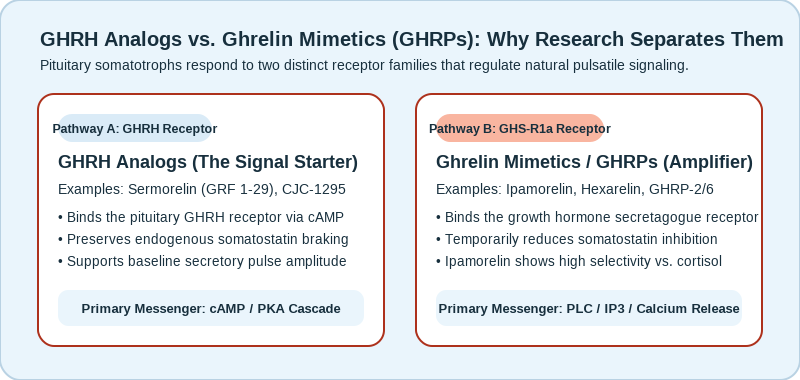
How Sermorelin Works: Preserving Pulsatile Feedback
A common misconception is that GHRH analogs and recombinant human growth hormone (somatropin / HGH) act identically. In endocrinology, their kinetics and safety mechanisms differ fundamentally:
1. GHRH Receptor Activation and Somatotroph Transcription
When Sermorelin binds the G-protein-coupled GHRH receptor (GHRH-R) on anterior pituitary somatotroph cells, it activates adenylyl cyclase, raising intracellular cyclic AMP (cAMP) and activating Protein Kinase A (PKA). This both triggers exocytosis of stored growth hormone vesicles and stimulates transcription of the pituitary GH1 gene so somatotrophs replenish their hormone stores (PubMed).
2. Intact Negative Feedback via Somatostatin and IGF-1
When exogenous synthetic HGH (somatropin) is injected directly, circulating growth hormone rises in a prolonged "square wave" regardless of endogenous feedback, which can cause supraphysiological IGF-1 elevations, peripheral edema, carpal tunnel syndrome, insulin resistance, and suppression of endogenous pituitary somatotroph output.
Because Sermorelin acts upstream at the pituitary gland, two physiological safety brakes remain active:
- Hypothalamic Somatostatin Brake: Somatostatin (growth hormone-inhibiting hormone) is released in an alternating ultradian rhythm from the hypothalamus. Even in the presence of Sermorelin, somatostatin prevents continuous, non-pulsatile GH hypersecretion.
- Hepatic IGF-1 Negative Feedback: Once the liver produces sufficient Insulin-Like Growth Factor-1 (IGF-1) in response to GH pulses, circulating IGF-1 feeds back on the hypothalamus and pituitary to down-modulate further GH release.
3. Rapid Enzymatic Cleavage by DPP-IV
Like native GHRH, unmodified Sermorelin has a very short plasma half-life measured in minutes because the circulating enzyme dipeptidyl peptidase-4 (DPP-IV) rapidly cleaves the N-terminal end of the peptide chain, rendering the fragment inactive. This rapid clearance produces a brief, physiological pulse rather than a multi-day elevation—and is the exact reason chemists later modified four amino acids to create longer-acting analogs such as CJC-1295 / Mod GRF 1-29.
What Published Research Evaluated
Because Sermorelin was a genuinely approved pharmaceutical, it was evaluated in human clinical studies examining pituitary growth hormone secretion, age-related somatotropic decline, and sleep regulation:
- Pituitary Growth Hormone & IGF-1 Regulation: Clinical studies of GHRH(1-29) in adults with age-related declines in growth hormone secretion examined how stimulating the pituitary GHRH receptor restores pulsatile nocturnal GH release and raises circulating IGF-1 toward physiological reference ranges while preserving feedback regulation (NIH PMC), (PubMed).
- Sleep Architecture & Nocturnal GH Pulses: Endocrine research also investigated the physiological link between hypothalamic GHRH signaling, deep slow-wave sleep stages, and nighttime somatotroph secretion (PubMed). See our guide on peptides studied for sleep and circadian rhythm.
Comparison: Sermorelin vs. CJC-1295, Ipamorelin, and Exogenous HGH
| Compound | Molecular Class | Plasma Half-Life | Receptor & Feedback Profile | U.S. Regulatory History |
|---|---|---|---|---|
| Sermorelin (GRF 1-29) | Unmodified GHRH(1–29) amide | Short (minutes; rapid DPP-IV cleavage) | Pituitary GHRH-R; preserves pulsatile somatostatin feedback | FDA-approved as Geref (1997); discontinued 2008 (not for safety) |
| CJC-1295 | Tetrasubstituted GHRH(1–29) (with or without DAC) | ~30 min (no DAC) / 6–8 days (with DAC) | Pituitary GHRH-R; DAC version causes sustained baseline GH/IGF-1 elevation | Never FDA-approved; 503A Category 2 nomination withdrawn |
| Ipamorelin | Pentapeptide ghrelin mimetic (GHRP) | ~2 hours | Pituitary GHS-R1a (ghrelin receptor); selective for GH without cortisol/prolactin rise | Not FDA-approved; ipamorelin acetate remains in Category 2 under 503B and also appears in the withdrawn table. |
| Recombinant HGH (Somatropin) | Full 191-amino-acid growth hormone | ~2–4 hours (subcutaneous) | Direct peripheral GH receptor binding; bypasses and suppresses pituitary feedback | FDA-approved prescription drug with strict statutory prescribing restrictions (21 U.S.C. § 333(e)) |
FDA Regulatory History and Current Legal Status
Sermorelin has a unique regulatory history among growth-hormone-related peptides:
- 1997 FDA Approval (Geref): The U.S. FDA approved Sermorelin acetate (marketed as Geref) in 1997 for pediatric growth hormone deficiency.
- 2008 Voluntary Commercial Discontinuation: In 2008, the manufacturer voluntarily discontinued Geref for commercial reasons unrelated to safety or efficacy.
- Compounding & Prescription Status: Because Sermorelin was previously FDA-approved and was not withdrawn for safety or effectiveness reasons, licensed U.S. physicians may prescribe compounded Sermorelin when clinically indicated, and it is not on the FDA's withdrawn Category 2 nomination list that restricted CJC-1295.
Clinical Consultation, Pharmacy Access, Cost Components & Insurance Coverage
Because Sermorelin is available through licensed U.S. medical channels when clinically appropriate, accessing it follows a structured medical workflow rather than unverified online retail:
- How Clinical Consultation Works: A licensed physician or endocrinologist conducts an initial medical evaluation reviewing symptoms, medical history, and contraindications, and orders baseline blood work (typically including serum IGF-1, metabolic markers, and thyroid function). Periodic follow-up lab panels are used to monitor hormone levels and safety over time.
- Legal Pharmacy Access: With a valid patient-specific prescription, Sermorelin is dispensed by state-licensed U.S. compounding pharmacies that operate under regulatory oversight and source pharmaceutical-grade ingredients—avoiding the contamination and mislabeling risks of unverified online sellers.
- Cost Components & Insurance Coverage: Total out-of-pocket expenses typically consist of four qualitative components: the initial physician consultation, baseline and follow-up laboratory blood panels, the monthly compounded medication supply, and sterile administration supplies. Because health insurance plans rarely cover Sermorelin when prescribed for adult wellness or age-related GH decline, patients generally pay out of pocket. See How Much Do Peptides Cost? for a broader comparison.
Safety Profile, Side Effects, and Contraindications
Reported side effects of Sermorelin are generally mild and most commonly include localized injection-site reactions (redness, swelling, or temporary discomfort), transient facial flushing, mild headache, dizziness, or mild nausea. Rare allergic reactions require immediate medical attention.
Contraindications & Pregnancy/Breastfeeding Caution: Growth hormone and IGF-1 signaling raises safety questions in malignancy, retinal disease and glucose intolerance. Human reproductive safety for Sermorelin is unestablished; personal prescribing and monitoring decisions belong with a licensed clinician. Read Are Peptides Safe?, Side Effects & Risk Factors, and Do I Need a Prescription? for full details.
Scientific References and Further Reading
- Growth Hormone-Releasing Hormone (GHRH) and Aging: Endocrine Regulation (PubMed)
- Effects of Growth Hormone Releasing Hormone on Body Composition - National Institutes of Health
- Clinical studies of growth hormone-releasing factor in healthy elderly subjects - PubMed
- Growth Hormone Releasing Hormone - StatPearls - NCBI Bookshelf
- Effect of Growth Hormone-Releasing Hormone on Sleep in Elderly Men - PubMed